Request a quote
Get a Quote for Engine Filters
Email and phone are required. Leave anything you don't know blank.

Published
A fuel filter’s micron rating names the size of the particle the element removes, and on its own, the number means very little. Two filters can both be sold as “5 micron” and still perform differently, because a rating only means something once you know the efficiency percentage and the test standard behind it.
The confusion has a price. A fleet that fits a finer-than-specified primary element gets restriction and power loss. A buyer who trusts the number without confirming the engine build gets a second repair. This guide is written for engine-service filtration on generator sets, plant, marine, and fleet duty. By the end, you will be able to read a diesel fuel filter micron rating, compare two “5 micron” quotes on the same basis, and know exactly what to confirm before you order.
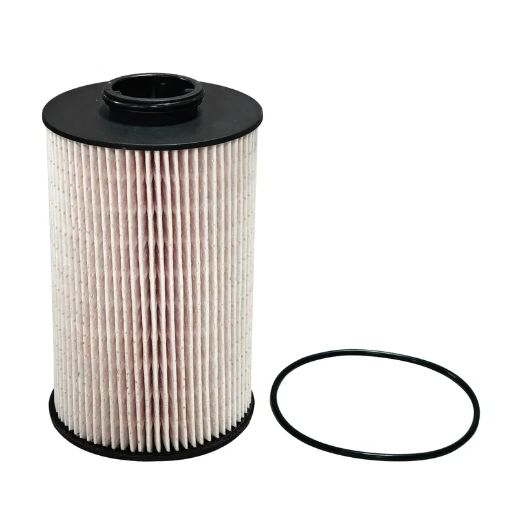
A micron (µm) is one millionth of a meter. Put it against something familiar: a human hair runs roughly 40-90 µm wide, so a filter rated at 10 microns is holding back particles finer than a hair. That comparison comes from filtration trade material, not from our own testing.
Here is the central fact, and the reason this whole guide exists. A filter labelled simply “10 micron” tells you nothing definitive unless you also know the efficiency percentage and the test method. That is the position of the Filter Manufacturers Council in its technical service bulletin TSB 89-5, and it is repeated by ALCO Filters in Technical Bulletin 5.
The reason is straightforward. A “5 micron nominal” filter might actually be a very good 20-micron filter, and an absolute 30-micron filter, depending on how the maker measured it. The number and the real performance are two different things.
So keep the two questions separate. “Micron rating” is a measurement question. “Will it fit my engine” is an identification question. A number answers only the first.
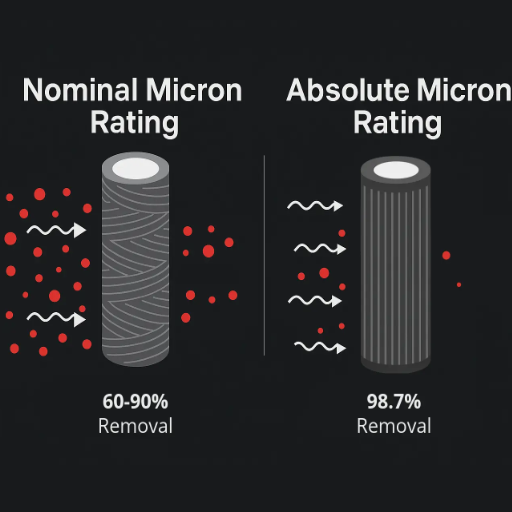
Two filters can both be called “10 micron” and behave differently, because nominal and absolute are different measurement bases. This is the difference a buyer needs to see before comparing two quotes.
| Attribute | Nominal rating | Absolute rating |
|---|---|---|
| What it means | The size at which the filter catches a stated percentage of particles | The size at which it catches a lab-verified cut-off (beta 75, or 98.7%) |
| Typical efficiency | Roughly 50-90% at the stated size | 98.7% at the stated size |
| Basis | Maker’s own method, often single-pass | Multi-pass lab test to a standard (ISO 19438, ISO 16889) |
| “Absolute” caveat | – | “Absolute” is 98.7%, not 100% |
| What it tells you | An approximate guide | A comparable, test-backed figure |
Every figure in that table comes from the linked sources: the Filter Manufacturers Council TSB 89-5, and the Donaldson and ALCO technical material. We publish no specific part-number rating anywhere on this page.
Marta runs purchasing for a plant maintenance team. Two suppliers each quoted her a “5 micron” fuel element for the same standby generator. One meant nominal, the other absolute. On the same basis, one element was meaningfully finer than the other, and only the quote that named the basis and the test standard was comparable. She asked both to state the basis. One could, one could not. She bought from the one that could.
This is exactly where reading a spec matters. See how the rating applies to a real element family in the Cummins fuel filters category.
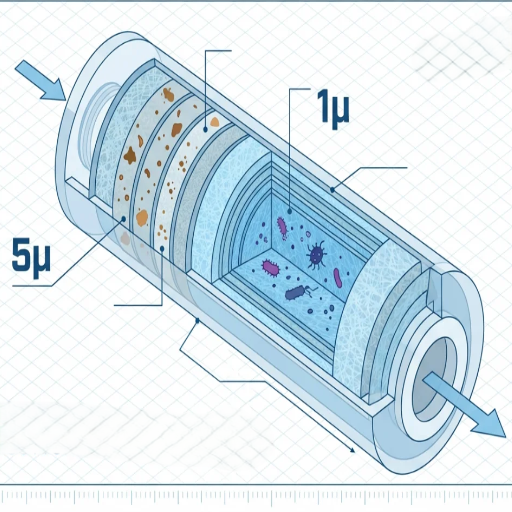
The fuel system filters in stages, and the two stages carry different ratings because they do different jobs. Fuel moves from the tank to a coarser primary element, then to a finer final-stage element that protects the injection system.
The primary or separator element removes water and bulk contamination, usually on the suction side of the fuel system. Donaldson describes these as roughly 10-30 µm nominal, with older systems historically in the 10-50 µm range. This is the coarser, high-capacity end of the system, and it also carries the water-stripping job.
On many installations, the primary stage and the water-separating stage are the same element. On others, a dedicated separator sits beside it. If your build uses both, list them separately and confirm each number. The Cummins fuel/water separators category covers that element on its own.
The final-stage element sits closer to the injection equipment and filters finer. On common-rail systems, Donaldson gives roughly 2-5 µm absolute for the secondary element, with ISO 19438 secondary ratings in the 4-5 µm absolute range. Its job is to protect the high-pressure pump and the injectors.
The stakes are higher than they look. Common-rail injectors run with clearances measured in single-digit microns and pressures above 30,000 psi, so a hard particle of a few microns causes abrasive wear. Donaldson’s technical material makes the case directly, and the SAE paper 2009-01-0874 reports that a two-stage arrangement improved common-rail fuel system life by up to 20 times.
That is why the final-stage rating is the one a buyer must get right. The cost difference between elements is trivial next to the cost of injection system work.
Finer is not a universal upgrade. A finer-than-specified primary element restricts flow and can cause power loss, which Baldwin’s service engineering guidance warns against for primary fuel filters. The correct rating is the one that matches the stage and the build, not the smallest number on offer.
Which element sits where in the fuel path is a question the primary vs secondary fuel filter guide covers in detail. This article stays with the numbers.
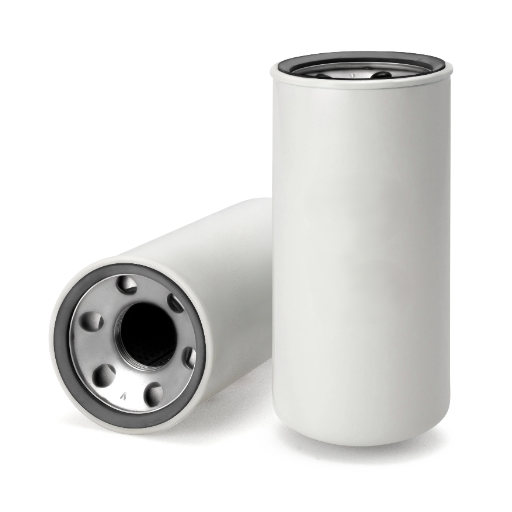
A meaningful rating states four things. If any one is missing, treat the number as incomplete.
The beta ratio is the modern way to state efficiency, and it converts directly to a percentage. The figures below come from the same filter-council bulletin and the beta-ratio standard:
Two filters are comparable only when they state the same micron size, on the same efficiency basis, under the same standard. A “5 micron absolute” and a “5 micron nominal” are not the same filter.
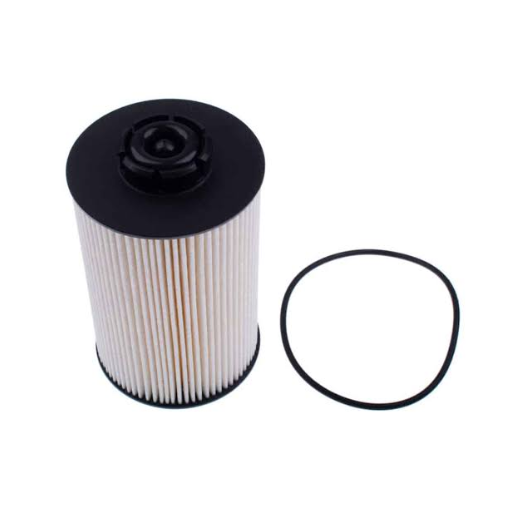
Here is the through-line of this article, stated plainly: a micron rating describes how fine a filter is. It does not tell you that the element fits your engine.
Two elements can share a micron rating and still differ in media, seals, valves, flow, and installed position. The same engine model can also carry different filter arrangements across production years. A number that describes the element’s fineness answers none of those fitment questions.
A Cummins owner on a 6BT-era engine asked a common question on a forum: should they run a 2-micron or a 5-micron element? The answer is not on a chart. It is in the build record for that engine and the number on the element they removed. A generic recommendation would have been the wrong way to settle it, and that is the point.
What micron fuel filter do I need for a diesel?
It depends on the engine build. Most systems run a coarser primary (roughly 10-30 µm) and a finer final stage (roughly 2-5 µm absolute on common rail). Confirm the specific rating against your engine’s manufacturer specification.
What does a micron rating mean in a fuel filter?
It names the particle size the filter removes. Without the efficiency percentage and the test standard, the number alone is not meaningful.
What is the difference between nominal and absolute micron rating?
Nominal is a percentage at a stated size, often 50-90%. Absolute is a lab-verified cut-off at 98.7% (beta 75). Two “10 micron” filters can differ widely.
Is a 2-micron or a 10-micron fuel filter better?
Neither is better in the abstract. The correct rating is the one specified for the stage and the engine build. A finer-than-specified primary restricts flow.
Can I compare two fuel filters by micron rating alone?
No. Compare only on the same basis: the same beta ratio or efficiency at the same micron size, under the same test standard. Then confirm the rating against your engine build.
Need help confirming a filter? Send the engine build, complete part number and quantity for review.
Request a Filter Quote